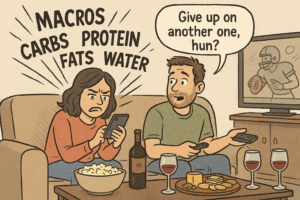
 Open almost any popular calorie tracking app today and you’ll find a world of complexity: barcode scanners, macro rings, food databases with 11 million entries, restaurant menus, social feeds, progress photos, challenges, and a subscription price that quietly renews every month. It’s impressive engineering — and for most people, it’s completely counterproductive.
The dirty secret of calorie counting is that the apps haven’t failed because people don’t care enough. They’ve failed because the daily friction of using them is too high. When something takes three minutes to log, most people stop logging it. And once logging becomes inconsistent, the whole system collapses.
Complexity is the enemy of consistency.
And consistency is the only thing that actually moves the needle.
The App Abandonment Problem Is Real
Research consistently shows that while millions of people download health and fitness apps each month, most are abandoned within the first week. The most common reason isn’t lack of motivation — it’s friction. The logging process itself becomes a chore, and eventually a source of guilt when skipped.
This isn’t a discipline problem. It’s a design problem. And the solution isn’t a better tutorial or a streak notification — it’s a fundamentally different philosophy about what a calorie tracker should be.
What “Simple” Actually Means
Simple doesn’t mean stripped-down or low quality. It means every feature earns its place by making the core job easier — and anything that doesn’t is cut, even if it sounds impressive on a marketing page.
For calorie tracking, the core job is: know how many calories you’ve consumed today, and how many you have left. That’s it. Everything else is optional. Most of it is noise.
A calorie tracker should be something you open, log into in under 15 seconds, close, and forget about until the next meal. If it takes longer than that — or if you leave with more anxiety than you arrived with — the app has failed at its job.
Type the food, see your number, move on
The fastest path to sustainable calorie tracking is logging by name. You type “chicken breast” and the app fills in 165 calories. Done. No camera, no barcode scan, no scrolling through 40 database results trying to figure out if yours was pan-fried or grilled. You already roughly know what you ate. The app just helps you count it.
Real-time pacing changes everything
One of the most underrated features a calorie app can have is telling you not just how much you’ve eaten — but whether your current pace is on track for the day. If it’s 3pm and you’ve used 70% of your daily budget, that’s valuable information. Most apps only show you totals. Smart apps show you context.
One number, always visible
Your calories remaining should be pinned at the top of the screen at all times. Glance and go. The moment you have to navigate somewhere to find that number, you’ve introduced friction — and friction compounds.
Macros Are Overrated (For Most People)
Protein, carbs, fat, fiber — this information matters for specific goals and medical situations. But for the average person trying to manage their weight, macros are a level of complexity that costs more in cognitive overhead than they return in results.
The fundamental equation of weight management is: calories in vs. calories out. Getting that number right consistently, day after day, is the work. Everything else is refinement for people who have already nailed the fundamentals — which most people haven’t, because they burned out on a complicated app before they got there.
Simple vs. Complex: An Honest Comparison
| What matters for results | Simple tracker | Complex app |
|---|---|---|
| Know calories remaining today | ✓ Instant | ✓ Eventually |
| Log a meal in under 30 seconds | ✓ Usually <15s | ✗ Often 1–3 min |
| Works offline | ✓ | ✗ Mostly not |
| Data stays private (your device only) | ✓ | ✗ On their servers |
| No recurring cost | ✓ Pay once | ✗ $10–20/month |
| Sustainable daily habit | ✓ Designed for it | ✗ Most people quit |
The Subscription Model Is Working Against You
Here’s something the big calorie apps would prefer you didn’t think about: their business model depends on you staying subscribed, not on you achieving your goal. An app that costs $15/month has a financial incentive to keep adding features you’ll feel guilty for not using — because engagement (not outcomes) is what justifies the recurring charge.
A tool you buy once and own forever has a fundamentally different relationship with you. It just needs to work. Your success is its only advertisement.
The best calorie tracker is the one you’ll actually open every day. Not the most powerful one. The most usable one.
How to Build a Sustainable Tracking Habit
Set a realistic daily goal. Not aggressive. Not aspirational. Realistic. A modest deficit you can sustain for weeks beats a dramatic one you abandon in three days.
Log before or immediately after eating — not at the end of the day when memory is fuzzy. The habit is strongest when it’s tied directly to the behavior.
Use favorites aggressively. You probably eat 20–30 different foods on rotation. Star them all in the first week. After that, logging is mostly just one tap per item.
Don’t punish over-days. One day over budget doesn’t ruin anything. The goal is the weekly average, not perfection. An app with a streak feature should celebrate wins, not amplify guilt.
Watch the pacing indicator more than the total. Knowing you’re ahead of pace at 2pm is more useful than knowing your total at 10pm. It changes your decision-making in the moment, which is when it actually matters.
Simple calorie tracking works because it removes every reason to quit. No complicated setup. No daily chore. No monthly bill reminding you to feel bad about not using it enough. Just your number — clearly, quickly, every day.
The Right Tool Makes All the Difference
If you’ve tried calorie tracking before and burned out, there’s a good chance it wasn’t a willpower problem. It was a tool problem. The right approach is a tracker built on a single philosophy: open it, log, close it, get on with your day.
That’s exactly what Calories.Today is designed for. No account. No subscription. No barcode scanner. No macro rings. Just your calorie goal, a fast food log, and real-time pacing to guide you through the day. Pay $17 once, use it forever, own your data completely.