You’ve been doing everything right. And then the scale just… stops. Here’s what’s actually happening — and why it doesn’t mean you failed.
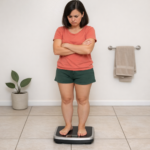 You were losing weight. Not fast, but steadily. You’d check the scale every few days and the number would be a little lower. You felt like it was working — because it was.
Then it stopped.
You didn’t change anything. You’re still logging. Still eating roughly the same. But the scale has been sitting on the same number for two, maybe three weeks. Maybe a month. And a voice in the back of your head is starting to say the thing it always says: Maybe this just doesn’t work for me.
Stop. Before you quit, before you change everything, before you decide your metabolism is broken — read this. Because what’s happening to you has a name, it has a cause, and most importantly, it has a fix that doesn’t require turning your life upside down.
What a Plateau Actually Is (And Isn’t)
A weight loss plateau is when your scale weight stops moving for two or more weeks despite being in a calorie deficit.
It is not a sign that you’ve failed. It is not proof that your approach is wrong. It is not your body “holding onto fat” for mysterious reasons.
It is your body doing exactly what bodies do: adapting.
When you lose weight, your body gets smaller. A smaller body burns fewer calories — at rest, during exercise, and during every ordinary thing you do throughout the day. This is called adaptive thermogenesis, and it’s not a flaw in the system. It’s the system working precisely as designed.
The problem is that the calorie deficit you started with no longer matches the body you have now.
The Math That Most People Miss
Let’s say you calculated your daily calorie target three months ago when you weighed 195 pounds. That number — let’s call it 1,800 calories — was right for that body. You ate at 1,800, your body burned more than that, and you lost weight.
But you don’t weigh 195 anymore. You weigh 178. And a 178-pound body burns fewer calories than a 195-pound one. At some point, 1,800 calories stopped being a deficit and became maintenance.
You didn’t plateau because you hit a wall. You plateaued because you succeeded — and didn’t update the math.
This is the most common cause of a plateau, and it’s the one almost nobody talks about. The fix is simple: recalculate your calorie target based on your current weight, not the weight you started at.
The Scale Is Also Lying to You (A Little)
Here’s something else worth knowing: the scale measures everything — fat, muscle, water, food currently being digested, and the weight of your skeleton. It is not a direct measurement of fat loss.
Water retention alone can mask weeks of real progress. Sodium makes you retain water. Stress makes you retain water. A hard workout makes your muscles hold water as part of the repair process. Your menstrual cycle, if you have one, causes significant fluctuations throughout the month.
This means you can be losing fat — actual fat — while the scale sits completely still or even ticks upward. The plateau you’re experiencing may not even be a real plateau. It may just be water noise on top of genuine progress.
The way to tell the difference: look at a longer window. If your average weight over the last two weeks is lower than your average weight two weeks before that, you are not plateaued. You are progressing through noise.
What to Actually Do
There are three levers. You don’t have to pull all of them. Pull the smallest one first.
1. Recalculate your target.
This is the first move. Update your calorie goal based on your current weight. In many cases, this alone is enough to break the stall.
2. Tighten your logging.
Plateaus are also a good time to be honest about whether your logging has gotten a little loose. Did you stop measuring cooking oil? Stopped logging the handful of crackers? Forgetting about the splash of creamer? These small gaps add up — not because you’re doing anything wrong, but because habits naturally relax over time. A week of careful logging often reveals a few hundred daily calories that had quietly crept back in.
3. Add a small activity increase.
You don’t need a new workout program. A 20-minute walk most days adds meaningful calorie burn over a week. If you’re already exercising, don’t do more — just make sure the intensity hasn’t gotten too comfortable. Your body adapts to exercise the same way it adapts to a diet.
That’s it. Three things. If one doesn’t work, try the next one. You do not need to cut to 1,200 calories. You do not need a cheat day. You do not need a cleanse.
What Not to Do
Don’t panic and slash your calories. Cutting too low causes muscle loss, makes you miserable, and makes the next plateau arrive faster because your metabolism adapts downward even further.
Don’t quit tracking. The plateau didn’t happen because tracking stopped working. It happened because the numbers need updating. The tracking is the tool that will get you out of it.
Don’t add a dozen new supplements. A plateau is a math problem, not a nutrition deficiency.
Don’t take a “diet break” just because the scale stopped. A break is fine if you genuinely need one mentally. But if you’re using the plateau as a reason to stop entirely, you’re letting a natural part of the process convince you to abandon something that was working.
The Patience Part (Nobody Wants to Hear)
Plateaus can last two to four weeks even after you’ve made the right adjustments. Your body doesn’t instantly respond to recalibration. You make the change, you stay consistent, and eventually the scale starts moving again.
The people who break through plateaus are not the ones with better genetics or better apps. They’re the ones who kept logging when the number wasn’t moving. They treated the plateau as a signal to adjust, not a reason to quit. They zoomed out, updated the math, and trusted the process to catch up.
That’s it. There’s no secret. It’s just not quitting.
How Calories.Today Helps
Calorie tracking during a plateau is where a simple, frictionless app matters most. When the scale isn’t moving, logging can start to feel pointless — and that’s exactly when you’re most likely to stop. An app that makes logging fast and effortless removes that friction.
Calories.Today is built for this. Log your food, see where you stand for the day, and keep moving. No macro wheels. No achievement badges. No lecture about your protein split. Just the number that matters, available the second you open the app.
If your plateau is a math problem — and it almost certainly is — the fix starts with knowing your actual daily intake. That requires tracking. And tracking requires a tool you’ll actually use.
Start tracking with Calories.Today →
You haven’t failed. Your body just caught up. Adjust the number and keep going.