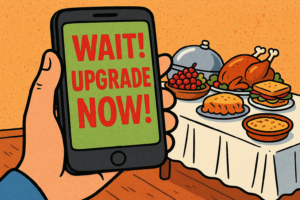
 I just wanted to log what I ate.
That’s it. I wasn’t training for a marathon. I wasn’t managing a medical condition. I wanted to drop a few pounds — and then, once I did, simply stay there. A few seconds a day to keep my number in check. That’s all I was ever asking for.
What I didn’t expect was that finding an app to help me do something that simple would become its own exhausting project.
Three Years of MyNetDiary — And One Popup Too Many
I started using MyNetDiary with a simple goal: lose a few pounds. Nothing dramatic. I knew the formula — eat fewer calories than you burn. I just needed something to help me keep track.
It worked. I lost the weight. And that’s when I made the mistake of thinking I’d keep using the app to maintain it.
Maintenance should be the easiest use case in the world. A few seconds a day, just to stay aware of my number. No big goals. No aggressive deficit. Just a daily check-in so things didn’t quietly drift back.
For three years I kept opening it. And for three years, I dealt with the same moment every single time.
I’d be in the middle of something — between chores, stepping away from my desk, grabbing a quick bite — and I’d open the app to log what I’d just eaten. Fast. Practical. That was the plan.
Instead, the first thing I saw wasn’t the food entry screen.
It was a popup. Reminding me I was on the free version. Urging me to upgrade.
Every. Single. Time.
I looked into the upgrade once. The premium features didn’t interest me. Macro tracking, detailed nutrient breakdowns, meal planning — none of it was what I needed. I eat a variety of foods. I was getting my nutrients. I just wanted to stay on top of my calories — the one number that actually matters.
I closed the popup. Again. Logged my food. And moved on — until the next time.
The Trap You Don’t Notice Until You’re In It
Here’s what I eventually realized about these apps: they’re not designed to get you in and out quickly. They’re designed to keep you engaged.
And engagement, in app terms, means time on screen. Features to explore. Menus to browse. Prompts to tap. Before long, what should have taken 15 seconds has eaten 10 to 15 minutes of your day — and you’ve accomplished nothing except the entry you came to make in the first place.
It’s almost hypnotic. Every notification, every badge, every “you’re missing out” banner is engineered to create a feeling that you’re not doing enough. That there’s more you should be tracking. That simplicity is somehow leaving something on the table.
It isn’t. For most people, calories are 90% of the equation. The rest is refinement for people who’ve already mastered the basics — which most of us haven’t, because we burned out on a complicated app before we got there.
I Searched Every Major App. They’re All the Same Book With Different Covers.
When I finally had enough, I went looking for an alternative. I went through every major calorie tracker I could find — Lose It, MyFitnessPal, you name it.
What I found was disheartening.
Every app had a different interface, different color scheme, different branding — but the same underlying architecture. Massive food databases. Macro rings. Barcode scanners. Onboarding flows with five screens of questions before you could log your first meal. And then, at the end of all that setup, a popup telling you that to really use the app, you’d need to upgrade.
One app even offered to identify my food from a photo. “Just snap a picture and we’ll log the calories for you.” I’m sorry — what? I can read a nutrition label. I know an apple is roughly 80 calories. The last I checked, when I buy something, the calories are right on the back of the package. Whatever happened to self-responsibility?
I spent a significant amount of time on this search. And I came away empty-handed.
The Business Model Is the Problem
Here’s what finally clicked for me: these apps aren’t really in the weight loss business. They’re in the subscription business.
When your revenue depends on monthly renewals, your incentives shift. You need users to stay engaged, stay dependent, and feel like canceling would mean losing something. A user who reaches their goal — and no longer needs the app — is actually a bad outcome for the business model.
44% of consumers are now experiencing “subscription fatigue” — exhausted by accumulating app costs, forced monthly payments, and hidden renewals.
I wasn’t surprised. I’d been living that frustration. I didn’t want to pay $10–20 a month just to log calories. I didn’t want a username and password. I didn’t want my data living on someone else’s server. I wanted a tool. One I owned. One that worked.
So I Built It.
I knew exactly what I wanted, and I knew it didn’t exist yet. So I built it for myself.
It took a while. But every time the project felt slow, I thought about those popups — and kept going.
The result was an app that lived right on my device. No account. No server. No login. No subscription. No popups. It opened to the food log. I typed what I ate. I saw my remaining calories. I closed it and got on with my day.
Everything I’d been looking for. In about 15 seconds.
Then I Realized Others Needed This Too.
Once I was using it daily and loving it, something occurred to me: I can’t be the only one who went through this. There have to be other people who just want the number — not the ecosystem.
So I made it available. The philosophy is simple:
- One number, always visible — calories remaining, pinned at the top, at all times.
- Log in under 15 seconds — type the food name, calories auto-fill, hit add. Done.
- Real-time pacing — not just your total, but whether you’re on track right now, based on the time of day.
- Your data stays on your device — no cloud, no server, no one watching.
- Pay once. $17. Use it forever. No subscription. No renewals. No popups.
A Note on the Free Version
You can try the full experience right now — no email, no credit card, no signup. Just open it and use it today.
If you decide to buy the full version, it’s $17 one time. Not $17 a month. Not $17 a year. $17, once, and it’s yours — including every future update, delivered free to anyone who’s purchased. Because not everything should cost a subscription.
If You’ve Been Where I’ve Been, You Already Know
If you’ve ever opened a calorie app just to make a quick entry — and found yourself fifteen minutes later somehow in a premium upgrade screen, wondering what just happened — you already understand why I built this.
The best calorie tracker isn’t the most powerful one. It’s the one you’ll actually open every day.
Try Calories.Today — Right Now. No Strings.
No signup. No credit card. No promises required.
Open it. Log something. See how 15 seconds feels.
If it’s what you’ve been looking for — and I think it will be — the full version is $17. One time. Yours forever.
You’ve been patient enough. Simple starts now.