Bad sleep doesn’t just make you tired — it chemically rewires your hunger signals the next day. Here’s exactly what happens inside your body, and why no amount of willpower fixes a sleep debt.
You tracked perfectly all week. Then you had two bad nights of sleep and blew your budget by 500 calories two days in a row — and you couldn’t explain why. You can now.
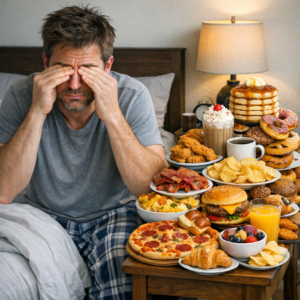 You woke up exhausted. You weren’t particularly stressed. You hadn’t skipped a meal. And yet by 3pm, you were ravenous in a way that felt almost desperate — the kind of hunger that laughs at willpower and makes a handful of crackers feel like an insult.
That wasn’t weakness. That was biology. And it started the moment you didn’t get enough sleep.
What Sleep Actually Does to Your Hunger Hormones
Your body regulates hunger through two hormones that work as a pair: ghrelin and leptin.
Ghrelin is the hunger signal — it rises when your stomach is empty and tells your brain it’s time to eat. Leptin is the fullness signal — it rises after you eat and tells your brain you’ve had enough.
When you sleep well, these two stay in balance. When you don’t, they go haywire — in the exact wrong direction.
One night of poor sleep is enough to measurably raise ghrelin and suppress leptin. Your hunger signal gets louder. Your fullness signal gets quieter. The result: you feel hungrier than you actually are, and you feel full later than you should.
This isn’t a feeling. It’s a measurable chemical shift in your blood. And it happens after a single bad night.
The Numbers Are Not Subtle
Research consistently shows that sleep-deprived people consume significantly more calories the following day — not because they decide to, but because their hormones are pushing them toward food with unusual force.
The extra intake tends to cluster around calorie-dense foods: things high in sugar, salt, and fat. This isn’t random. Your brain, running low on energy, prioritizes fast fuel. It wants the croissant, not the salad. It wants the chips, not the apple. And it wants more of whatever you give it, because the leptin signal that would normally say okay, that’s enough is operating at reduced volume.
Some studies put the average calorie surplus from a sleep-deprived day at 300–500 extra calories. Not from a single binge — just from a day of slightly larger portions, an extra snack, a heavier lunch, a late-night reach into the cupboard. Spread across a week of poor sleep, that’s a meaningful number.
Why Willpower Doesn’t Fix This
This is the part that matters most, because most people respond to a bad eating day by resolving to try harder tomorrow.
Willpower is a cognitive resource. It lives in the prefrontal cortex — the part of your brain responsible for decision-making, impulse control, and long-term thinking. Sleep deprivation specifically impairs that part of the brain. The region that’s supposed to help you pause and choose the better option is running at reduced capacity — at the exact same time your hunger hormones are running at elevated intensity.
You’re fighting harder with fewer resources. That’s not a personal failing. That’s arithmetic.
Telling yourself to just be more disciplined after a bad night is a bit like running a race with a twisted ankle and deciding the solution is better shoes. The problem isn’t effort. The problem is the conditions.
It’s Not Just Hunger — It’s the Food You Choose
Sleep deprivation doesn’t just make you want more food. It specifically shifts what you want toward high-calorie, high-reward options.
Your brain’s reward circuitry becomes more reactive when you’re tired. The anticipation of eating something pleasurable lights up more strongly. The satisfaction of eating something plain and sensible lights up less. You’re not craving chips because you lack self-control — you’re craving chips because your sleep-deprived brain is running a biased algorithm that makes those chips look approximately twice as appealing as they would otherwise.
This is also why sleep-deprived eating tends to happen in the evening. Tiredness accumulates across the day. By 9pm, you’ve been running on depleted resources for hours, your leptin is suppressed, your ghrelin is elevated, and your reward system is primed. The late-night fridge visit isn’t a character flaw. It’s the predictable output of a specific set of biological conditions.
What This Means for Your Calorie Tracking
If you’ve ever had a day where you just couldn’t stay on track — where the hunger felt real and relentless and no amount of water or distraction made it better — sleep is a reasonable first suspect.
This doesn’t mean you abandon tracking on tired days. Tracking is actually more valuable on hard days, not less, because it keeps the damage visible and contained. But it does mean you should:
Cut yourself some slack on the diagnosis. A day of overeating after bad sleep isn’t a willpower failure. It’s a predictable biological response to a specific input. Treating it as evidence that you “can’t do this” is both factually wrong and counterproductive.
Adjust your expectations, not your ceiling. You don’t need to eat more on a tired day just because you feel more hungry. But knowing the hunger is hormonally amplified lets you approach it with a different mindset — observing the signal rather than obeying it automatically.
Prioritize protein and volume on bad days. Protein is the most satiating macronutrient. Foods with high volume and low calorie density — vegetables, soups, anything with a lot of water in it — help occupy the stomach and quiet ghrelin without spending the entire day’s budget in one sitting. You’re not fighting the hunger. You’re redirecting it.
Treat sleep as part of the system. If you’re serious about calorie tracking and weight management, sleep is not separate from the project. It’s inside it. A person who sleeps well has a measurably easier time staying on target than the same person running on six hours. Not because they’re more disciplined — because their hormones are cooperating.
The Uncomfortable Implication
Most people treat weight management as a food problem. Track better, choose better, resist more. And yes — what you eat matters enormously.
But your body doesn’t operate in isolation. It’s a system, and sleep is one of the system’s core inputs. When that input is degraded, everything downstream gets harder: hunger increases, food choices worsen, willpower weakens, and the margin for error shrinks.
You can’t out-track a chronic sleep deficit. You can manage it — with awareness, protein, volume, and honesty about what’s driving the hunger. But the more sustainable move is to take sleep as seriously as you take your calorie budget. Because in terms of influence on what you eat and how much, they’re in the same conversation.
The days that feel hardest to track are often not food problems at all. They’re sleep problems that show up in the kitchen.
Calories.Today tracks just calories — no macros, no meal plans, just the number that matters. If you want simple, honest tracking that fits real life, try it free.