Most people don’t own a food scale. Most people who do own one stop using it within two weeks. Here’s how to estimate portion sizes accurately enough to make calorie tracking actually work — no equipment required.
Here’s a scenario that kills calorie tracking faster than any cheat meal:
 You log your dinner. But you don’t actually know how much pasta is in the bowl. You guess. You write down “1 cup.” It was probably 2. You’ve just accidentally eaten 300 calories you didn’t account for — and you’ll do it again tomorrow, and the day after, and wonder in three weeks why the numbers aren’t adding up.
Portion size estimation isn’t about being precise to the gram. It’s about being consistent enough that your tracking means something. And you can do that without a scale, without measuring cups, and without turning every meal into a lab experiment.
Here’s how.
Why Portion Size Estimation Is the Skill That Actually Matters
Food scales are accurate. They’re also annoying, time-consuming, and completely impractical for 90% of real eating situations — restaurants, someone else’s kitchen, a work lunch, a dinner party.
The people who succeed long-term at calorie tracking aren’t the ones who weigh everything forever. They’re the ones who develop a calibrated sense of portion sizes that travels with them everywhere, because it’s built into their own hands and eyes.
That’s what this is about.
Your Hand Is a Better Measuring Tool Than You Think
Hand-based portion estimation works because your hand is roughly proportional to your body. A bigger person has a bigger hand — and generally a higher calorie budget. It scales naturally.
These aren’t perfect. They’re close enough.
Your fist = 1 cup
Use this for: pasta, rice, cereal, salad, cut fruit, popcorn, cooked vegetables.
A fist-sized portion of cooked pasta is about 200 calories. Most restaurant servings are two to three fists. That gap is where a lot of unaccounted calories live.
Your palm (no fingers) = 3–4 oz of protein
Use this for: chicken, fish, beef, pork, tofu — any protein source.
The thickness matters too, not just the surface area. Your palm at roughly the thickness of a deck of cards is a standard serving. Most people eat one to two palms of protein per meal, which is reasonable.
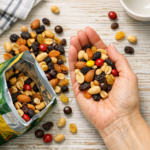
Your cupped hand = 1–2 tablespoons of nuts, dried fruit, or small snacks
Use this for: almonds, walnuts, raisins, granola, seeds.
One small cupped handful of almonds is about 160–180 calories. These are the portions people most frequently underestimate — small, easy to grab more of, calorically dense. Log them carefully.
Your thumb = 1 tablespoon of fat
Use this for: peanut butter, butter, oil, mayo, cream cheese, salad dressing.
One thumb of peanut butter is about 90–100 calories. Two thumbs is a standard serving most people think of as “a spoonful.” Oils and dressings are easy places to lose 200 calories without noticing — a thumb-based check here pays off.
The tip of your thumb = 1 teaspoon
Use this for: oils drizzled, spreads, sauces, added sugars.
Small, but relevant if you’re adding olive oil to a pan every day or spreading something on toast.
Common Objects That Work as Reference Points
When you can’t use your hand — if you’re eyeballing a plate from across a table, or estimating from memory — object comparisons are surprisingly reliable once you’ve internalized them.
- A deck of cards = 3 oz cooked meat (about 150–200 calories depending on cut)
- A tennis ball = 1 medium piece of fruit or about 1 cup of most foods
- A golf ball = 2 tablespoons of peanut butter, hummus, or similar spreads (~180 calories)
- A standard AA battery = 1 oz of hard cheese (~110 calories)
- A hockey puck = 1 medium bagel (most bagels are actually closer to 2–3 pucks — this is where people are routinely surprised)
- A postage stamp = roughly 1 teaspoon of butter or oil
- Your smartphone = a reasonable approximation of a medium serving of fish or chicken breast
None of these are exact. All of them are close enough that the error is smaller than the error of just guessing freely — which is what most people do.
The Foods That Trip People Up Most
Some foods have a massive gap between what people think a serving is and what it actually is. These are worth knowing specifically.
Pasta and rice
A standard serving of cooked pasta or rice is about 1 cup — roughly one fist. Most home-cooked bowls are 2–3 cups. Restaurant servings can be 4 cups or more. If you’ve ever wondered why pasta meals don’t seem to “fit” in your calorie budget even though you’re tracking them, this is probably why.
Cereal
The serving size printed on the box is almost always ¾ cup or 1 cup. The bowl you’re actually pouring is usually 2–3 cups. Granola especially — at 400+ calories per cup — deserves careful measurement until you’ve genuinely calibrated what a portion looks like in your actual bowl.
Cooking oil
A tablespoon of olive oil is 120 calories. If you’re “drizzling” oil into a pan, you’re almost always adding more than a tablespoon. A genuine tablespoon looks like barely anything. One pour from the bottle is often 2–3 tablespoons. This is one area where actually measuring once or twice — just to see what it looks like — is worth the effort.
Nuts and nut butters
Calorically dense and very easy to eat more of than you realize. A serving of almonds is 23 nuts (about 160 calories). A serving of peanut butter is 2 tablespoons (about 190 calories). These are two thumb-widths of peanut butter in a spoon — not a heaping scoop. Worth calibrating once, then trusting your eye.
Cheese
A serving of hard cheese is 1 oz — roughly the size of a AA battery or two dice stacked. A “handful” of shredded cheese is usually 2–3 oz without feeling like it. Not a disaster, but something to log with awareness rather than with optimism.
Salad dressing
Two tablespoons is standard. Most people pour 4–6 tablespoons, or use enough to coat every leaf thoroughly. At 60–120 calories per tablespoon for oil-based dressings, this can add 200–400 unlogged calories to what felt like a virtuous salad. The two-tablespoon-on-the-side approach (and dipping your fork) is a legitimate calorie control hack.
How to Build the Skill (Without Making Every Meal Annoying)
You don’t need to do this forever. You need to do it until your eye is calibrated — which takes less time than most people expect.
Step 1: Pick 5 foods you eat regularly and actually measure them once. Not forever. Once. Cook your normal amount of rice. Then measure it after. See the number. That visual is now burned in.
Step 2: Log your estimates, then check yourself occasionally. If you have a scale or measuring cups available, use them every few weeks on something you estimate frequently. See how close you are. Adjust.
Step 3: Pay attention to containers and plates. A restaurant pasta bowl holds more than your bowl at home. A coffee shop muffin is not the same size as the nutrition label’s suggested serving. The container shapes your perception of a “normal” amount — and it’s often not accurate.
Step 4: When in doubt, estimate high. Most people’s instinctive errors go in one direction: underestimating. If you’re unsure whether that’s a fist or 1.5 fists of rice — log 1.5. You’ll be right more often than if you log the lower number.
What Level of Accuracy Is “Good Enough”?
Research on self-reported calorie intake consistently shows that even trained dietitians underestimate their calories by around 10–15%. Regular people tend to underestimate by 20–40%.
You don’t need to be perfect. You need to be consistent and roughly calibrated.
If your estimates are 10–15% off but consistent, your trend data is still useful. You’ll see whether things are moving in the right direction. You can adjust based on real-world results — if you’ve been at your estimated deficit for three weeks and the scale hasn’t moved, the likely explanation is that your estimates are running a bit high, and you can tighten them.
The goal of portion estimation isn’t laboratory accuracy. It’s replacing “I have no idea” with “I have a reasonable, consistent idea.” That alone is enough to make tracking meaningful.
One Habit That Makes This Dramatically Easier
Eat the same things regularly.
This sounds obvious, but it’s underrated as a calorie control strategy. If you eat the same breakfast most days, you only need to estimate that portion once. If your lunch rotation is 5 meals, you estimate each one once and then you’re done. Most of your calories end up being known quantities.
Variety is fine. But the more you rotate the same reliable meals, the less cognitive load the whole system takes — and the more accurate your tracking becomes over time without any extra effort.
You don’t need a food scale to track calories accurately. You need a calibrated eye, a few reference points, and the habit of erring on the side of logging slightly more rather than slightly less. That’s it.
Start with the foods you eat most. Measure them once. Let the visual stick. Your hand will do the rest.
Calories.Today tracks just calories — no macros, no meal plans, just the number that matters. If you want simple, honest tracking that fits real life, try it free.