Calorie density explains why two people can eat the same number of meals and one is full while the other is starving. Once you understand it, you’ll never think about food the same way again.
You’re tracking perfectly. You’re hitting your calorie goal. You’re still hungry by mid-afternoon every single day.
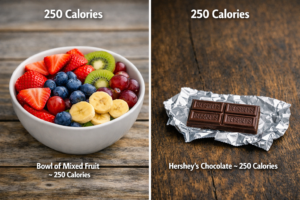 That’s not a willpower problem. It’s a calorie density problem — and it’s one of the most common reasons people feel like calorie tracking is harder than it should be.
What Is Calorie Density?
Calorie density is the number of calories in a given weight of food — usually measured per 100 grams.
A food with low calorie density gives you a large physical amount of food for relatively few calories. A food with high calorie density gives you a small physical amount of food for a lot of calories.
That’s the whole concept. But the implications are enormous.
Your stomach registers fullness based largely on volume and weight — not calories. When your stomach stretches, it sends satiety signals to your brain. When it doesn’t, you stay hungry. This means two people can eat the exact same number of calories and have completely different hunger experiences depending on what those calories are made of.
The goal of calorie tracking isn’t to eat less food. It’s to spend your calorie budget on foods that actually fill you up. Calorie density is how you do that.
Calorie Density at a Glance
Here’s how common foods compare per 100 grams:
| Food | Calories per 100g | Density |
|---|---|---|
| Cucumber | 16 kcal | Very low |
| Leafy greens (spinach, lettuce) | 20–25 kcal | Very low |
| Strawberries | 32 kcal | Very low |
| Cooked oats | 71 kcal | Low |
| Cooked rice | 130 kcal | Low–medium |
| Boiled chicken breast | 165 kcal | Medium |
| Cheese (cheddar) | 400 kcal | High |
| Chocolate | 550 kcal | High |
| Almonds / mixed nuts | 580 kcal | Very high |
| Cooking oils | 880–900 kcal | Extremely high |
Notice the extremes. A tablespoon of olive oil is around 119 calories — and you’d barely notice eating it. A full plate of cucumber and spinach is under 50 calories. Same stomach space. Completely different calorie cost.
Why You Feel Hungry Even When You’re “Eating Enough”
If you’ve ever tracked calories carefully and still felt hungry most of the day, here’s what’s probably happening.
A day of high calorie density eating might look like this:
- Breakfast: granola and yoghurt — 500 calories in a small bowl
- Lunch: a sandwich and some crisps — 600 calories, gone in 10 minutes
- Dinner: pasta with olive oil and cheese — 700 calories, a reasonable-looking plate
That’s 1,800 calories. But physically? Very little food. Low volume. Short eating time. Minimal chewing. Your stomach never really got full.
Now compare to a day of low calorie density eating:
- Breakfast: big bowl of oats with berries — 400 calories, genuinely filling
- Lunch: large salad with chicken, chickpeas, and lots of veg — 450 calories, an enormous plate
- Dinner: stir fry with shrimp, broccoli, peppers, and rice — 550 calories, a full plate
That’s only 1,400 calories — and you’d feel significantly more satisfied. More food. More volume. More time eating. More fullness signals sent to your brain.
The second day isn’t just lower in calories. It’s physically more food. That’s the whole point.
High vs. Low Calorie Density Foods
Low calorie density foods (the ones to lean on)
These are foods where you get a large amount of physical food per calorie:
- Most vegetables — especially raw or steamed
- Fresh fruit — particularly berries, melon, and citrus
- Broth-based soups and stews
- Lean proteins — chicken breast, white fish, shrimp, egg whites
- Cooked legumes — lentils, beans, chickpeas
- Plain cooked grains — oats, rice, potatoes (boiled or baked, not fried)
High calorie density foods (handle with awareness, not fear)
These aren’t bad foods. They’re just calorie-concentrated, which means small amounts eat up a large portion of your daily budget:
- Oils and butter
- Nuts and nut butters
- Cheese and full-fat dairy
- Bread, pastries, crackers
- Chocolate and sweets
- Ultra-processed snacks — crisps, cookies, granola bars
The word here is awareness, not elimination. You don’t need to stop eating nuts or cheese. You need to know that a small handful of almonds is 170 calories — and a full bowl of strawberries is 50.
How to Use Calorie Density When You’re Tracking
1. Anchor your meals with low-density foods first
Start every meal with the lowest calorie density elements — a side salad, a bowl of soup, a big serving of roasted vegetables. They take up physical space in your stomach before you get to the higher-calorie parts of the meal. You’ll naturally eat less of those without trying.
2. Swap, don’t eliminate
You don’t need to give up anything to apply calorie density thinking. You make smarter swaps where it matters most:
- Crisps → plain popcorn (same crunch, dramatically fewer calories per cup)
- Pasta-heavy bowl → pasta plus double the vegetables
- Peanut butter by the spoon → peanut butter on apple slices
- Cheese-heavy omelette → egg white base with one yolk and lots of veg
3. Watch your cooking fats
This is the sneakiest calorie density trap. A drizzle of olive oil looks like nothing. It’s often 100–150 calories. Sauté your vegetables in a splash of broth or water instead, or use a spray oil that lets you control exactly how much you’re using. The food tastes nearly identical. The calorie impact is not.
4. Use volume as a satisfaction signal
When you’re planning a meal, ask: does this look like enough food? Not enough calories — enough food. If your plate looks sparse, add a cucumber salad, some sliced tomatoes, a handful of leafy greens. Zero guilt. Real satiety boost.
5. Make lean protein your base
Lean protein sits in the middle of the calorie density spectrum — lower than fats, higher than vegetables — and it drives fullness harder than almost any other food. Building meals around lean protein plus vegetables is the most reliable way to feel satisfied on a calorie deficit.
Three Calorie Density Mistakes to Avoid
Assuming “healthy” means “low calorie density”
Avocado is nutritious. It’s also 160 calories for half of one. Nuts are genuinely good for you. They’re also 580 calories per 100g. Health and calorie density are not the same thing — a food can be healthy and extremely calorie-dense simultaneously. Don’t let a health halo make you forget to log it carefully.
Drinking your calories
Liquid has almost no effect on stomach fullness — it passes through too quickly to stretch your stomach the same way solid food does. A 300-calorie smoothie will leave you just as hungry as before you drank it. Eat your fruit; don’t drink it.
Forgetting about sauces and dressings
A tablespoon of Caesar dressing: 80 calories. Two tablespoons on a salad: 160 calories from something that added no volume at all. Dress your food — but measure, or switch to lower-density alternatives like salsa, lemon juice, or balsamic vinegar.
The Bottom Line
Calorie density isn’t a diet. It’s not a rule you have to follow perfectly. It’s a lens — a way of thinking about food that makes calorie tracking feel less like deprivation and more like strategy.
When you understand it, you stop feeling like you’re fighting your appetite. You redirect it. More cucumber, more chicken, more oats, more soup. Less oil, less cheese, less granola. Same calories — or fewer. More food.
If you’re tracking calories and still feel hungry most of the time, don’t cut more. Change what you’re eating. Volume is your friend.
You’re still eating. You’re just eating smarter.
—
Calories.Today tracks just calories — no macros, no meal plans, just the number that matters. If you want simple, honest tracking that fits real life, try it free.