Reading time: ~6 minutes
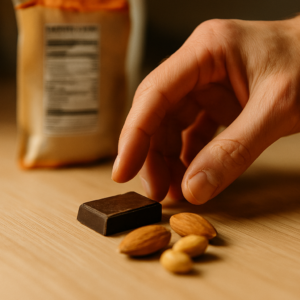 You’ve been here before. You set a 2,000-calorie daily limit, you open a nutrition label, and the math doesn’t come out clean. You’re not using a kitchen scale. You don’t want to use a kitchen scale. You make a reasonable estimate—and then the second-guessing begins. What if I’m off by 10 calories? What about 20?
By evening, you have 105 calories left. The snack that would actually satisfy you is 120. Fifteen calories. You skip it, feel deprived, and somewhere deep in the back of your mind, a small voice says: this is stupid. And eventually, you agree with that voice. The diet ends not with a dramatic cheat meal but with a quiet surrender over a number smaller than the rounding error on a granola bar.
Sound familiar? This loop—starting strong, hitting the precision wall, abandoning ship, waiting, trying again, repeat—is one of the most common reasons people never reach their goals. And the fix isn’t more willpower or a better app. It’s a mindset shift about what calorie counting is actually measuring.
The Precision You’re Protecting Doesn’t Exist
Here’s the part nobody tells you when you start tracking calories: the number on the nutrition label is itself an estimate. The FDA allows a 20% margin of error on food labeling, which means a snack listed at 120 calories could legally contain anywhere between 96 and 144 calories. The scale you didn’t want to use would still be measuring something approximate.
It goes further than that. Your body doesn’t absorb every calorie listed. Cooking methods change calorie bioavailability. Your gut microbiome affects how much energy is extracted from food. The “2,000 calories” baseline is a population average that may bear little resemblance to your actual metabolism on any given day.
In other words: you are stressing over 15 calories within a system that has hundreds of calories of inherent variability baked into it. The anxiety is real. The precision it’s protecting is not. Once you genuinely internalize this, calorie tracking transforms from a math test you keep failing into a useful compass that helps you navigate in the right direction.
What “Good Enough” Actually Looks Like in Practice
Allowing yourself a margin for error is not the same as abandoning your goals. It’s actually the more scientifically accurate way to approach tracking. Think of your daily calorie target not as a hard ceiling but as the center of a range. If your goal is 2,000 calories, landing anywhere between 1,850 and 2,150 on any given day is a near-perfect execution. The 120-calorie snack that leaves you satisfied? It almost certainly falls inside that window. And even when it doesn’t, one day at 2,200 matters almost nothing in the context of a week.
A tool like Calories.Today is designed precisely for this kind of big-picture awareness. As you log throughout the day, small estimation errors average themselves out—some entries will run slightly high, others slightly low. The aggregate picture remains genuinely useful even when no individual entry is perfectly precise. Consistency over weeks and months is where real results come from, and no level of daily precision matters if the rigidity of the system causes you to abandon it by week three.
The Psychology of the Calorie Counting Loop
Understanding why the loop happens is the first step to breaking it. The mechanism is almost always the same: perfectionism masquerading as diligence. When we treat calorie tracking as a pass/fail system with a precise daily threshold, we create countless small opportunities to “fail.” And each small failure chips away at motivation until the whole endeavor feels pointless.
The voice that says this is stupid after the 15-calorie snack incident is not a reasonable voice. It’s an all-or-nothing thinking pattern—a cognitive distortion that has nothing to do with biology or math. Recognizing it as a pattern rather than a truth is powerful. You do not have to obey it just because it showed up.
5 Psychological Strategies to Build Your Margin-of-Error Mindset
1. Reframe What Success Looks Like
Instead of “I hit exactly 2,000 calories today,” make the win “I stayed aware today.” These are very different mental targets and the second one is actually achievable. Awareness without perfection is the engine of long-term change.
2. Stop Treating Each Day as a Unit of Failure or Success
Your body doesn’t reset at midnight. What matters is the trend across a week. A Tuesday where you went 200 over doesn’t ruin anything if the overall week is reasonable. When you zoom out to a weekly view, daily fluctuations shrink into noise. Calories.Today makes this easy to see in the aggregate—use it.
3. Separate the Tracking From the Judging
Log what you ate without immediately attaching a verdict to it. The number is just information. A lot of people abandon tracking not because they ate too much, but because they couldn’t stand the feeling of writing it down. Neutral observation is a skill worth practicing. Log it, move on.
4. Respect the Effort in Difficult Moments
That moment in the kitchen, doing mental math and feeling stuck over 15 calories—that is a moment of genuine effort. You’re trying. That deserves acknowledgment rather than a spiral into abandonment. Give yourself credit for showing up to the decision at all, even when the decision doesn’t feel clean.
5. Understand That Satisfaction Has Its Own Caloric Value
A person who eats the satisfying snack, feels good, and stays consistent for months will almost always outperform someone who skipped it, felt resentful, and quit by week three. Deprivation has a cost that doesn’t show up in any nutrition label. Factor it in.
How to Apply This With Calories.Today
Calories.Today is built for sustainable tracking—not obsessive counting. Here’s how to use it in a way that supports a margin-of-error mindset rather than undermining it.
- Set your target, then build in a buffer. If your goal is 2,000 calories, treat 2,100 as your soft ceiling rather than a failure state.
- Log consistently, not perfectly. An approximate entry is far more valuable than a missing one.
- Check your weekly average before drawing conclusions. A single high day is data, not disaster.
- When the all-or-nothing voice shows up, name it. “That’s the perfectionism pattern.” Then log the snack anyway.
The Goal Was Never Perfect Numbers
The goal is a body and a life you feel good in. Calorie tracking is one of the most effective tools available to get there—but only when it’s used as a compass rather than a verdict. The margin of error isn’t a loophole. It’s an accurate reflection of how nutrition actually works.
Stop trying to be precise inside an imprecise system. Start trying to be consistent. That’s where results live.
Start tracking smarter today with Calories.Today.