You did everything right yesterday. Then you stepped on the scale and it showed a number higher than last week. Here’s exactly why — and why it means nothing about your progress.
You didn’t gain fat. You gained information — and most people don’t know how to read it.
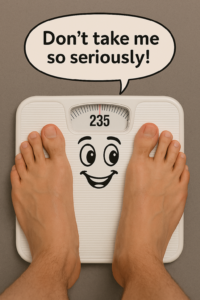 That number on the scale this morning? It is not a measure of your fat. It’s a measure of everything in your body right now: water, food in transit, glycogen in your muscles, hormones, and yes, the sodium in that “healthy” meal you had last night.
Most people quit here. Right at this moment. They ate well, they tracked everything, and the scale went up — and their brain files that as proof that it isn’t working. So they stop.
That’s the most expensive mistake in weight loss. And it’s almost never based on reality.
What the Scale Is Actually Measuring
Your body weight on any given morning reflects dozens of variables that have nothing to do with fat gain or fat loss.
Water retention. Sodium causes your body to hold water. So does carbohydrate — your muscles store carbs as glycogen, and glycogen holds water with it. Eat a high-carb or high-sodium meal and you can retain 2–4 pounds of water by the next morning. That’s not fat. It flushes out within 24–48 hours.
Digestion. Food you ate yesterday is still in your digestive system. A full stomach, a backed-up colon — all of it adds weight on the scale. None of it is fat.
Inflammation. A hard workout causes microscopic muscle damage, and your body sends fluid to the area to repair it. You can wake up heavier after a great training session. Again — not fat.
Hormones. Cortisol (your stress hormone) causes water retention. Poor sleep spikes cortisol. So does a tough week at work. So does undereating. The scale will reflect all of it.
The number isn’t lying. It’s just not telling you what you think it’s telling you.
The Math Doesn’t Lie — But You Have to Do the Math
Here’s a number worth remembering: 3,500 calories.
That’s roughly how much of a caloric surplus it takes to gain one pound of actual body fat. If you ate 500 calories over your goal yesterday — a big day, not a catastrophic one — you gained about 1/7th of a pound of fat. Less than two ounces.
If the scale went up two pounds, it wasn’t fat. It was water, food, glycogen, and normal biological noise.
The people who make consistent progress are the ones who understand this. They don’t let a single morning’s number derail a week of effort. They zoom out. They look at trends, not data points.
Why This Moment Is Where Most People Quit
Nobody talks about this enough: the scale going up after a good day is one of the most demoralizing experiences in weight loss — and it happens to almost everyone.
You were disciplined. You tracked everything. You went to bed feeling proud. Then the scale handed you what feels like a punishment.
Your brain doesn’t know the difference between a real threat and a perceived one. When it sees that number, it treats it as evidence that your effort isn’t working. And when effort doesn’t feel like it’s working, your motivation collapses. That’s not weakness. That’s how brains work.
The fix isn’t more willpower. It’s better information.
Once you understand that scale weight is noisy data — that it bounces around by 2–4 pounds on any given day for reasons completely unrelated to fat — you stop letting it run your emotions. The number becomes just a number. Interesting data, nothing more.
What to Do Instead of Panicking
1. Weigh yourself at the same time every day.
Always in the morning, after using the bathroom, before eating or drinking anything. This minimizes variables and gives you the cleanest comparison.
2. Track a weekly average, not a daily reading.
Add up your weights for the week and divide by seven. That average, compared to last week’s average, is your real trend line. A single high day gets smoothed out completely.
3. Look for the trend over two to four weeks.
One week doesn’t tell you much. Two to four weeks of data tells you everything. If your average is drifting down over time, your plan is working — even on the weeks where individual days look ugly.
4. Drink your water.
This sounds backwards, but dehydration actually causes your body to retain more water as a protective mechanism. Staying well-hydrated helps your body flush the excess. Aim for enough that your urine is pale yellow throughout the day.
5. Don’t punish yesterday’s sodium with today’s restriction.
The classic mistake after a high-scale morning is to under-eat the next day to “compensate.” This almost always backfires — it spikes cortisol, signals scarcity to your metabolism, and creates the restrict-retaliate cycle that derails most diets. Just eat normally. The water comes off on its own.
The Honest Truth About Progress
Fat loss is not linear. There is no version of this process where the scale goes down every single day. That’s not a flaw in your plan. That’s biology.
What consistent fat loss actually looks like is: up two days, down one, flat for three, down again. A jagged line that, when you zoom out far enough, is trending in the right direction.
The people who reach their goal are not the people who had the smoothest ride. They’re the people who didn’t quit on the days the scale lied to them.
You’re going to have mornings where the number doesn’t make sense. Now you know why. Now you know it doesn’t mean what you thought it meant.
Keep tracking. Keep going. The trend will tell the truth.
Simple calorie tracking — no macros, no meal plans, no guilt. Just the number you need and a clear picture of your trend over time. Try Calories.Today free →